
A five-year-old roof with localized hail damage is very different from a 20-year-old roof with widespread wear. But both scenarios start with the same anxious phone call.
This guide breaks down roof repair vs. roof replacement so you can evaluate your specific situation. You'll understand the real differences and make a confident decision that protects your home without wasting money.
We'll walk through how to assess damage severity and understand what each option actually delivers. You'll learn the key factors—age, extent of damage, and material condition—that tip the scale one way or the other. You'll also discover when a partial replacement might be the smart middle ground.
By the end, you'll have a clear framework for your decision. And if you need an expert eye on your specific situation, we're here to help with a free inspection.
How Do I Know If My Roof Needs Repair or Replacement?
Your roof likely needs repair if:
- Damage is localized to less than 30% of the roof surface
- Your roof is under 15 years old
- Only a few shingles are missing or damaged
- Leaks are isolated to one area
Your roof likely needs replacement if:
- Damage covers more than 30% of the surface
- Your roof is 20+ years old and approaching the end of its lifespan
- You see widespread curling, missing granules, or sagging
- Multiple leaks or repeated repairs in different areas
Age is the biggest factor. Even minor damage on an aging roof often means replacement is more cost-effective long term. A professional inspection can give you a definitive answer.
Need an expert assessment? Request a free roof inspection in Harford County
Understanding the Core Difference Between Roof Repair and Replacement
Roof repair means fixing specific damaged areas on your existing roof. We replace damaged shingles, seal flashing around chimneys or vents, or patch underlayment in isolated spots. The rest of your roof stays in place.
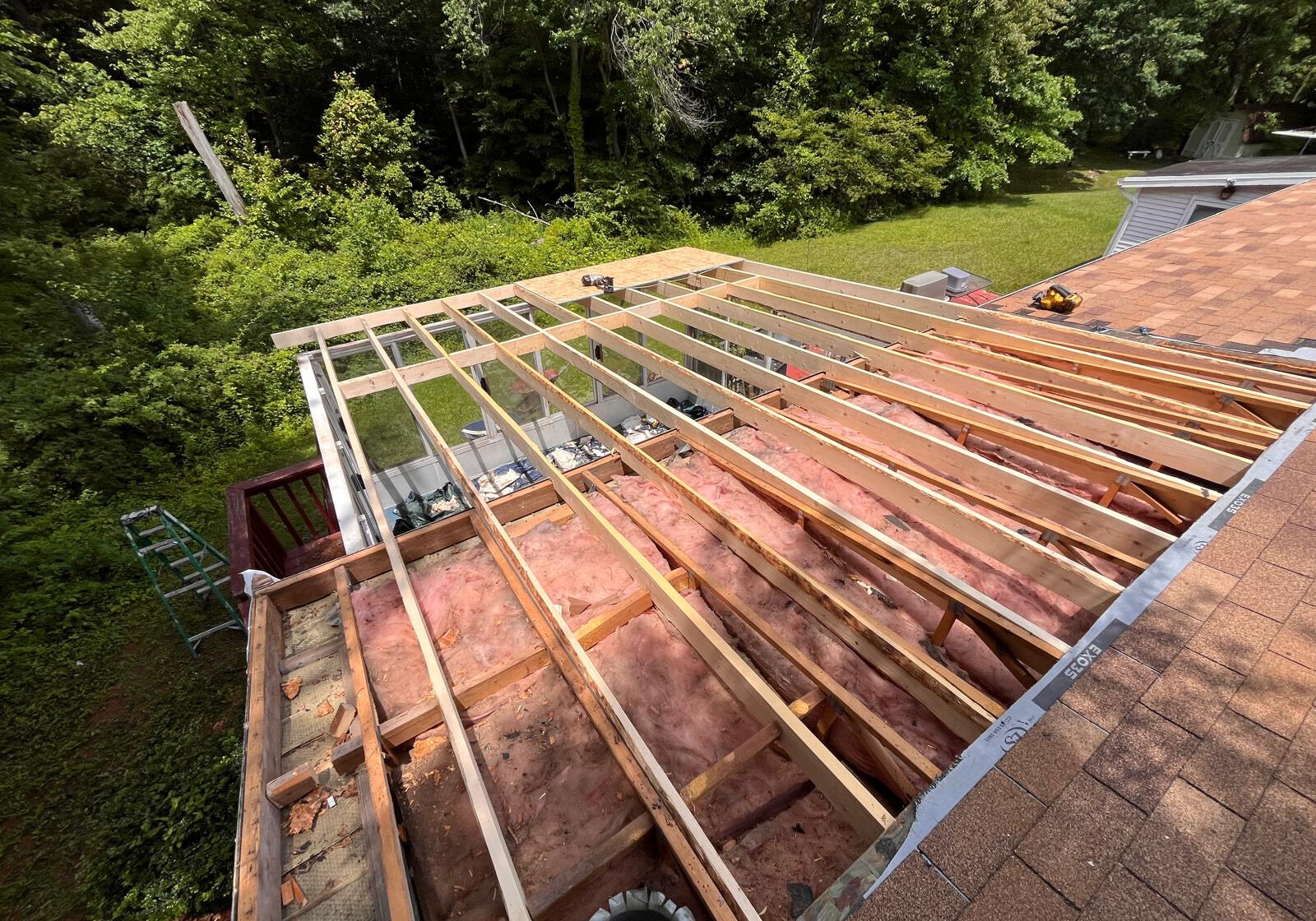
Roof replacement means removing all existing materials down to the wooden decking. We then install a complete new roofing system—underlayment, drip edge, shingles, and all components. Nothing from the old roof remains.
There's also a middle option: partial replacement. This means replacing one slope or section of your roof while leaving the rest intact. We'll cover when this makes sense later.
Timeline matters too. Most repairs take a few hours to two days. Full replacements take one to five days depending on your home's size and roof complexity.
Here's the key difference: Repair addresses the symptom you can see. Replacement addresses the entire system.
In our 20+ years serving Harford County homeowners, we've found people are often surprised that repair doesn't always mean "just a few shingles." Sometimes the flashing, underlayment, or even decking needs attention too. A proper repair fixes the visible damage and the underlying cause.
Once you understand what repair actually involves, the next question is: when is it the right move for your situation?
When Roof Repair Is the Right Choice (And When It's Not)
Repair absolutely makes sense in the right situations. If a storm damaged eight to 10 shingles on your seven-year-old roof, repair is the clear choice. Same goes for an isolated leak from a backed-up gutter when the rest of your roof is sound.
Here's the money-saving truth: If your roof has 10+ years of life left and damage is truly isolated, repair protects your investment. It maintains your existing manufacturer warranty and keeps your roof performing as designed.
Repair typically makes sense when:
- Your roof is under 12 to 15 years old
- Damage covers less than 20 to 30% of the total roof area
- Surrounding shingles are still flexible with minimal granule loss
- You have an isolated problem with a clear cause
- The rest of your roof shows no signs of widespread wear
Warranty preservation matters. If you have a newer roof with localized damage, repair maintains your existing warranty coverage. Replacement means starting a new warranty clock.
Warning signs repair won't be enough:
- You've had multiple repairs in the past two to three years
- Shingles across the roof show widespread wear or brittleness
- You're approaching the end of your manufacturer warranty period
- Problems keep appearing in different areas
If you're seeing these red flags, repair often becomes a short-term fix. You'll likely face replacement within a few years anyway.
Of course, knowing when repair works also means knowing when it doesn't. Here are the clear signs replacement is the smarter choice.
Clear Signs Your Roof Needs Full Replacement
Age is the biggest indicator. Most asphalt shingle roofs last 20 to 25 years. If your roof is approaching or past that mark, replacement is likely your best option—even if damage seems minor right now.
Visual signs you can spot from the ground:
- Shingles curling up at the edges or cupping in the middle
- Bald spots where protective granules have worn away
- Visible sagging along the roofline
- Daylight coming through boards when you're in the attic
Multiple problems signal system failure. One leak is an isolated issue. Three leaks in different areas over two years means your roof is failing in multiple places.
Failed repairs tell the story. If a patch didn't hold or problems returned within one to two years, your roof has moved past the repair stage. You're treating symptoms while the underlying system continues to decline.
Extensive storm damage changes the equation. When hail or wind affects 40% or more of your roof surface, replacement becomes the practical choice. Patching that much area rarely makes financial sense.
Hidden decking damage matters most. Soft spots when you walk on the roof, water stains on attic ceiling joists, or visible mold in your attic all point to compromised decking underneath.
During inspections, we use moisture meters to check decking condition. Homeowners can't see this damage from ground level, but it's often the deciding factor. Once the decking is compromised, patching shingles above it doesn't solve the real problem.
Not sure what category your roof falls into? Our licensed roofers provide detailed inspections and honest recommendations—no high-pressure sales.
Understanding the Investment vs. the Expense
Here's a helpful way to think about it: Repairs are expenses that solve today's problem. Replacements are investments that solve today's problem and eliminate worry for the next 20+ years.
Both have their place. The question is which one fits your situation.
The hidden costs of delaying replacement:
- Interior water damage to ceilings, walls, and insulation
- Structural rot in decking or rafters that compounds over time
- Emergency tarping services during storms
- Multiple service call fees adding up over several years
- Damage that spreads and makes eventual replacement more expensive
Small leaks cause hidden damage you can't see. What starts as isolated shingle damage can become rafter replacement if left too long. The cost of doing nothing is rarely zero.
What affects the scope of your project: Roof size, pitch complexity, material choice, and underlying damage all play a role. Every roof is different. Some homes have simple gable roofs that move quickly. Others have multiple valleys, dormers, or steep pitches that require more time and care.
We educate you on what your specific situation requires—no surprises, no pressure.
Insurance considerations matter. When damage is extensive or storm-related, replacement may be fully or partially covered while repair isn't. Many insurance policies have age limits that affect coverage. In some cases, homeowners find their insurance won’t cover older roof systems at all. If your roof is older, your claim may face depreciation or denial.
Home value and buyer confidence: A new roof adds marketable value to your home. Buyers see it as one less thing to worry about. Multiple visible repairs signal deferred maintenance—buyers wonder what else has been patched instead of fixed properly.
We've worked with homeowners who spent several thousand dollars on repairs over two to three years, then still needed replacement. That money didn't add any life to the roof or value to the home. It just delayed the inevitable.
Beyond the immediate fix, there's another option many homeowners don't know exists.
What About Partial Roof Replacement?
Partial replacement means replacing one slope, section, or side of your roof while leaving the rest intact. It's a middle-ground option that many homeowners don't realize is available.
This works well when: Significant damage is isolated to one area of your roof. Common examples include a south-facing slope with sun damage, an addition built onto your home several years ago, or a garage section separate from the main house.
The sweet spot is a mid-life roof—around 10 to 15 years old—where one section has failed but the rest is genuinely solid. You're not ready to replace the entire roof, but repair won't adequately address the damaged section.
The matching challenge: Finding shingles that match your existing roof in color and style can be difficult. If your original shingles were discontinued, we may not find an exact match. Even with the same product line, weathering means your new section may look visibly different from the rest of your roof.
For some homeowners, that color difference is fine. For others who prioritize curb appeal, it's a dealbreaker.
When partial replacement doesn't make sense: If the undamaged sections are within five years of needing replacement anyway, you're better off doing the whole roof now. You avoid the hassle of two separate projects and eliminate the color-matching issue entirely.
Partial replacement maintains some of your existing roof investment while addressing critical areas. It's not right for every situation, but when it fits, it can be the smart choice.
Now that you understand the options, here's how to actually make your decision.
How to Make Your Decision (Decision Framework)
The right answer depends on three factors working together—age, damage extent, and your home's timeline. There's no universal rule that applies to every roof.
Start with a simple decision tree:
First, check your roof's age. Then assess damage extent. Consider your repair history. Finally, evaluate your plans for the home.
Quick Decision Guide: Repair or Replace?
- Roof under 10 years old + isolated damage → Repair almost always makes sense
- Roof 10-15 years old + moderate damage → Could go either way; inspection determines best path
- Roof 15-20 years old + any significant damage → Replacement usually better value
- Roof 20+ years old → Replace regardless of damage extent
When professional inspection is necessary: You need expert eyes for decking damage, structural issues, warranty questions, and insurance documentation. These aren't things you can reliably assess from the ground.
What to expect from our inspection: We provide a visual assessment of your entire roof, moisture testing of the decking, attic inspection, manufacturer warranty review, and a written report with photos. You'll see exactly what we see.
A professional inspection removes the guesswork. You'll know exactly what you're dealing with, not just surface symptoms.
We provide written inspection reports with photos. Many homeowners use these to show insurance adjusters exactly what's needed. It can make the difference in claim approval.
Your timeline matters too. If you're planning to sell within two to three years, replacement makes your home more marketable. If roof replacement is likely within three to five years anyway, repair may just be delaying an expense you can't avoid.
The framework helps, but your specific situation is unique. That's where an honest, experienced assessment makes all the difference.
Trust Krause Companies with Your Home
With decades of local experience, a commitment to quality, and hundreds of satisfied customers, Krause Companies is proud to be Forest Hill, MD’s trusted roofing expert. We understand that replacing your roof is a significant investment, and we’re here to make the process as smooth and stress-free as possible—from your first call to final inspection.
Let us make your next roof replacement a smart, worry-free investment. Protect your home, boost its curb appeal, and enjoy peace of mind for years to come with Krause Companies at your side.
Contact us today to schedule your free inspection or to learn more about our services. Your home deserves the best—trust Krause Companies for your next roof replacement in Forest Hill, MD.